Part III. Mathematics Advancements by Muslims:
Introduction: Just as with science, the Muslims learned from the Greeks, Egyptians, Indians, and Babylonians. Many translations took place in the House of Wisdom in Baghdad, the capital of the Abbasid Empire. The Muslim scholars there translated the works of the Greeks who loved mathematics and geometry, including Euclid's work on geometry. They borrowed from India a number system that had a zero and rewrote it as their own. They borrowed from the Babylonians whose number system was based on 60 (just like the minutes in an hour), and from the ancient Egyptians who had the math and geometry skills to build incredible pyramids. So from the beginning, "Arabic math" was a mixing of international knowledge. But the Muslims made additional contributions of their own, and through their study and written work, they preserved the knowledge of mathematics that otherwise might have been lost to the world.
|
Arithmetic:
|
Algebra:
|
Geometry:

|
Trigonometry:

|
|
Arab contributions: - the numbers we use are called Arabic numbers (numerals) which is a system of tens, with place values, and a zero to show an empty place: 1,302,005 - fractions: 1/2 - decimal fractions: 1.5
|
Arab contributions: Algebra was first fully developed by Al Khwarism, the "father of algebra". |
Arab contributions: The Arabs translated and improved upon the Egyptian, Hebrew, and Greek geometry. |
Arab contributions: Al-Tusi, a Muslim, is the "father of trigonometry". |
|
The decimal (tens place) system first came from India. Al Khwarismi reworked these numbers and gave us Arabic numerals. Much later Europeans changed the Arabic numerals into the numerals we use today. Al-Khwarizmi wrote about squares and square roots, first studied by the Greeks and Egyptians.
 = 3 = 3Al-Khashi (from Persia, 15th century) invented decimal fractions: 5.25 |
In Khwarizmi's own words what he wanted to teach: "...what is easiest and most useful in arithmetic, such as men constantly require in cases of inheritance, legacies, partition, lawsuits, and trade, and in all their dealings with one another, or where the measuring of lands, the digging of canals, geometrical computations, and other objects of various sorts and kinds are concerned..." |
The Egyptians were very advanced in geometry and could build great pyramids. The Greeks loved geometry. The most famous Greek mathematician was Euclid who wrote about geometry. The Arabs translated and improved upon his work. The Hebrews also had made important contributions to mathematics that were studied by the Arabs. |
The idea of trigonometry was originally from the Greeks, by Hipparchus in 140 BCE. The Muslims further developed trigonometry from their work in astronomy. Today astronomers use trigonometry for calculating distances to stars, and for measuring distances and heights of buildings, trees, etc. |
 r2
r2
A. Arabic Numerals
One of the greatest advances was the introduction of "Arabic" numerals. The "Arabic" numerals were influenced by India's mathematics. It is a system based on place values and a decimal system of tens. This system had a zero to hold a place. These numbers were much easier to use for calculation than the Roman system which used numbers, like I, V, X, L, C, M, etc. Addition, subtraction, multiplication and division now became easy.

- Top: Western Arabic or Hindu-Arabic Numerals
- Below: Modern Arabic numerals which developed from them

With Arabic numerals, simple fractions and decimal fractions were also possible. Fractions and decimal fractions were also described by Muslim mathematicians during the Middle Ages.
B. The Development of Algebra.
Al Khwarizmi wrote the first book on algebra. (The name "algebra" was first used by him.)

Al Khwarizmi was born about 790 in Baghdad (now in Iraq) and died about 850.
The word for "Algebra" comes from the Arabic word for "al-jabr" which means "restoration of balance" in both sides of an equation.. Algebra was based on previous work from Greeks, Alexandrians in Egypt, and Hindus who had preserved the work from ancient Egyptians and Babylonians.
In the ninth century, al-Khwarizmi wrote one of the first Arabic algebras with both proofs and examples. Because of his work, he is called "the Father of Algebra." Al-Khwarizmi was a Persian born in the eighth century. He converted (changed) Babylonian and Hindu numerals into a workable system that almost anyone could use. He gave the name to his math as "al-jabr" which we know as "algebra".
A Latin translation of al-Khwarizmi's book on algebra appeared in Europe in the 12th century. In the early 13th century the new algebra appeared in the writings of the famous Italian mathematician, Leonardo Fibonacci. So, algebra was brought into Europe from ancient Babylon, Egypt and India by the Arabs and then into Italy.
C. Geometry
The scholars at the House of Wisdom in Baghdad and at universities in Cairo, Egypt also contributed to geometry. Geometry was highly developed by the Greeks, and the Muslims translated such great Greek thinkers as Euclid. Muslims used their understanding of geometry into designing wheels of all kinds, especially waterwheels and other systems for drawing up water, in improving farming equipment, and in designing devices of war such as catapults and crossbows. Geometry was also put to work in art, with beautiful geometric designs. Muslims further defined Euclidian geometry, and pointed the way toward the discovery of independent, non-Euclidean geometry developed in the most recent centuries.
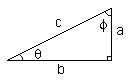
D. Trigonometry is also mostly a Muslim creation. It is a branch of mathematics which studies plane and spherical triangles. It developed from the need of astronomers to map points in the sky on a heavenly sphere. Trigonometry's functions, involving ratios such as sine and cosine, tangent and cotangent, were greatly developed and refined in the Islamic lands.
E. Famous Muslim Mathematicians of the Middle Ages
1. Al-Khwarizmi (770 - 840 C.E.) was one of the greatest mathematicians who ever lived and is called the "Father of Algebra". He also helped to bring "Arabic numerals" into use into the Islamic Empire, as well as later into Europe. He also demonstrated operations with fractions for the first time. Khwarizmi influenced the growth of science and mathematics. Several of his books were translated into many other languages, and were used as university textbooks until the 16th century. His approach was systematic and logical. He brought together the knowledge of his time on various branches of science, especially mathematics, and also added his original contributions.
2. Omar Khayyam (1044 - 1123 C.E.): Another great Muslim mathematician was Omar Khayyam. He is best known today for his poetry, but his contribution to mathematics was great. He showed how to express roots of cubic equations by line segments obtained by intersecting conic sections. Khayyam was an outstanding poet, mathematician, and astronomer. His work on algebra was known throughout Europe in the Middle Ages, and he also contributed to a calendar reform. Khayyam refers in his algebra book to Pascal's triangle. The algebra of Khayyam is geometrical, solving linear and quadratic equations by methods appearing in Euclid's Elements. Khayyam also gave important results on ratios giving a new definition and extending Euclid's work to include the multiplication of ratios. He poses the question of whether a ratio can be regarded as a number but leaves the question unanswered.
3. Al-Khashi was born in 1390 in Kashan, Iran and died in 1450 in Samarkand (now Uzbek). He calculated ¼ (pi) to 16 decimal places which was the best until about 1700. He considered himself the inventor of decimal fractions. He wrote The Reckoners' Key which summarizes arithmetic and contains work on algebra and geometry.
4. Al-Biruni (973 - 1048 C.E.) was a philosopher, astronomer, pharmacologist (one who studies drugs and herbs used for health), botanist (one who studies plants), geologist and mathematician. He translated Euclid's work into Sanskrit (an Indian language), and calculated the earth's circumference (distance around the earth) and radius (distance to the center) with an accuracy that is close to today's measurements.
5. Nasir Al-Din Al-Tusi (1201 - 1274 C.E.) pioneered spherical trigonometry which includes six fundamental formulas for the solution of spherical right-angled triangles. One of his most important mathematical contributions was the treatment of trigonometry as a new mathematical discipline. He wrote on binomial coefficients which Pascal later introduced. (He can be called the "Father of Trigonometry".) He was also an astronomer philosopher, and medical scholar as well as a mathematician.
|
Learn more about Arab mathematicians:
 See Al-Khwarizmi
for explanation. See Al-Khwarizmi
for explanation.
|
Go to Part One, Islamic Science and Math
Go to Part Two: Chemistry, Astronomy, and Geography
Go to Part Three, Islamic Sciences: Medicine, Botany, Optics.
Go to Part Four, Islamic Sciences: Why did the "Golden Age" end?
You are here at Part Five, Islamic Mathematics