Islamic Science and Math (continued)
E. Technology:
For centuries, the dry and harsh environment of much of the Muslim lands made the collection, transportation, and storage of water important. It is hardly surprising that the most important progress in medieval Muslim technology and engineering was achieved in relation to water.
In the tenth century al-Kindi proposed a plan to dam the Nile. Many of the dams, reservoirs, and aqueducts constructed at this time throughout the Islamic world still survive.
Photo: At Hama in Syria, antique wooden wheels still lift the waters of the Orontes to gardens, baths, and fountains.
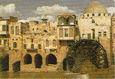 Syrian waterwheel still
working. (Islam.org)
Syrian waterwheel still
working. (Islam.org)
Muslim engineers also perfected the waterwheel and built underground water channels some fifty feet underground. The underground channels had manholes (openings from the street) so that they could be cleaned and repaired.
|
What were some other Muslim inventions and technological achievements?
|

F. Agriculture
Agricultural advances are also part of the Muslim legacy. Important books were written on soil, water, and what kinds of crops were suited to (fit best with) what soil. Many new plants were introduced into all parts of the Muslim empire from Africa, Europe, and from as far away as India and China. Farmers made advances in these areas of agriculture:
1. grafting (cutting of a branch from one plant and putting it onto another)
2. fertilizers (used to make the fields more fertile and grow more)
3. new plant varieties
III. Arabic words are still used as English scientific terms:
Examples of Arabic words that are now part of scientific English include algebra, algorithm, chemistry, alchemy, zircon, atlas, almanac, earth, monsoon, alcohol, elixir, aorta, pancreas, colon, cornea, diaphragm, and many more!
IV. Why did this "Golden Age" of science and learning end? [This is an adaption and simplification of The Golden Age of Islam (Stormwind.com).]
The Abbassid Empire became weaker in the 12th century. But from its golden beginnings in the mid-8th century until the destruction of Baghdad by the Mongols in 1256, Arabic culture was unequalled in its splendor and learning. It was a period of almost 500 years!
A. Why did Islam's Golden Age come to an end? What forces shifted both political power and learning from the Islamic Empire to Christian Europe?
Like all historical trends, the explanations are complex. Yet some broad outlines may be identified, both within and without Muslim lands.
1. Internal Pressures (From Inside the Empire): the End to Scientific Progress
With the end of the Abbasid Caliphate and the beginning of the Turkish Seljuk Caliphate in 1057 CE, the centralized power of the empire began to shatter. Religious differences resulted in splinter groups, charges of heresy, and assassinations. Aristotelian logic, adopted early on as a framework upon which to build science and philosophy, appeared to be undermining the beliefs of educated Muslims. Orthodox faith was in decline and skepticism on the rise.
The appeal made by theologian (a person who studies religion and about the nature of God) al-Ghazali turned the religious tide back to orthodox (traditional) belief. In a masterful philosophical argument, most clearly stated in his book, The Destruction of Philosophy, al-Ghazali declared reason and all its works to be bankrupt. Experience and the reason that grew out of it were not to be trusted; they could say nothing meaningful about the reality of Allah. Only direct intuition of God led to worthwhile knowledge. Philosophy was a snare, leading the unwary to the pits of Hell. By the time of his death in 1111, free scientific investigation and philosophical and religious toleration were phenomena of the past. Schools limited their teaching to theology (religion and the nature of God). Scientific progress came to a halt.
2. External Pressures (From Without)
During this same period, the European Crusades (1097-1291) weakened the Islamic Empires' powers from without. Cordoba fell to Spanish Christians in 1236. When the Mongols sacked Baghdad in 1256 the Islamic Empire never recovered. Trade routes became unsafe. Urban life broke down.
Individual communities drew in upon themselves in feudal isolation. Science and philosophy survived for a while in scattered pockets, but the golden age of Islamic culture was at an end.
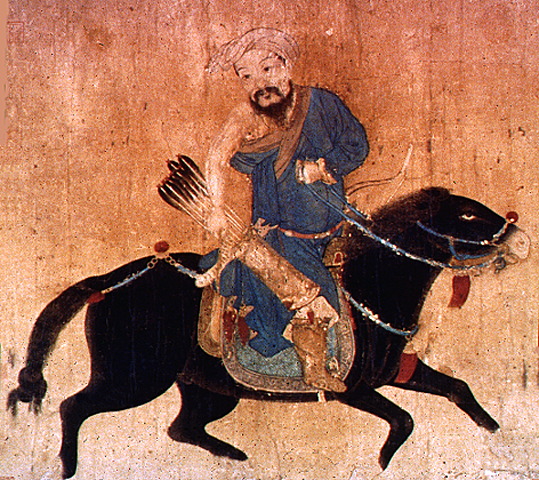 Mongol archer
B. Destruction of Books and Libraries
1. The fall of Baghdad (1258) meant the end of the Abbasid Caliphate. Two million Muslims were massacred (killed, wiped out) in Baghdad. The major scientific institutions, laboratories, schools, and even roads and waterways in leading Muslim centers of civilization were destroyed. The books from the House of Wisdom were either burned or dumped into the Euphrates River. There were so many books dumped into the river that the waters turned black with their ink.
2. Another wave of destruction came when the Christians took over Spain in 1492. More than one million volumes of Muslim works on science, arts, philosophy and culture were burnt in the public square in Granada.
- Go back to Islamic
Science and Mathematics, Part One
Go to Advances in Sciences, Part Two
Go to Islamic Sciences, Part Three
You are at Islamic Sciences, Part Four