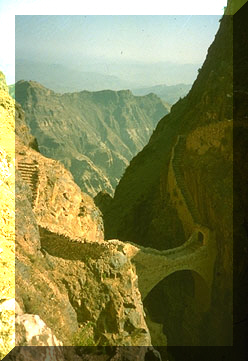
The history of the Yemen stretches back over 3,000 years, and its unique culture is still in evidence today in the architecture of its towns and villages. From about 1000 BC this region of the Southern Arabian Peninsula was ruled by three successive civilisations -- Minean, Sabaean and Himyarite. These three kingdoms all depended for their wealth on the spice trade. Aromatics such as myrrh and frankincense were greatly prized in the ancient civilized world and were used as part of various rituals in many cultures, including Egyptian, Greek and Roman. In the 11th century BC, land routes through Arabia were greatly improved by using the camel as a beast of burden, and frankincense was carried from its production centre at Qana (now known as Bir 'Ali) to Gaza in Egypt. The camel caravans also carried gold and other precious goods which arrived in Qana by sea from India. The chief incense traders were the Minaeans, who established their capital at Karna (now known as Sadah), before they were superseded by the Sabaeans in 950 BC. The Sabaean capital was Ma'rib, where a large temple was built. The mighty Sabaean civilisation endured for about 14 centuries and was based not only on the spice trade, but also on agriculture. The impressive dam, built at Ma'rib in the 8th century, provided irrigation for farmland and stood for over a millennium. Some Sabaean carved inscriptions from this period are still extant. The Himyarites established their capital at Dhafar (now just a small village in the Ibb region) and gradually absorbed the Sabaean kingdom. They were culturally inferior to the Sabaeans and traded from the port of al-Muza on the Red Sea. By the first century BC, the area had been conquered by the Romans. |
|
 |
|
 |
 |
 |
 |
|
With the rise of the great ancient civilizations in Egypt, Mesopotamia, and along the Mediterranean Sea, historic Yemen became an important overland trade link between these civilizations and the highly prized luxury goods of South Arabia and points east and south. As a result, several pre-Islamic trading kingdoms grew up astride an incense trading route that ran northwest between the foothills and the edge of the desert. First, there was the Minaean kingdom, which lasted from about 1200 to 650 BC, and whose prosperity was due mainly to the trade of frankincense and spices. The large and prosperous kingdom of Saba' (Sheba), founded in the 10th century BC and ruled by Bilqis, the queen of Sheba, among others, was known for its efficient farming and extensive irrigation system built around a large dam constructed at Ma'rib. Farther south and east, in the region that would later become South Yemen, were the Qataban and Hadhramaut kingdoms, which also participated in the incense trade. The last of the great pre-Islamic kingdoms was that of Himyar, which lasted from about the 1st century BC until the 500s AD (seeHimyarites). At their heights, the Sabaean and Himyarite kingdoms encompassed most of historic Yemen. Because of their prominence and prosperity, the states and societies of ancient Yemen were collectively called Arabia Felix in Latin, meaning "Happy Arabia." However, when the Romans occupied Egypt in the 1st century BC they made the Red Sea their primary avenue of commerce. With the decline of thecaravan routes, the kingdoms of southern Arabia lost much of their wealth and fell into obscurity. Red Sea traffic sailed past Yemen, and what seaborne commerce Yemen engaged in had little impact on the country's interior. The Tihamah region, which was hot, humid, swept by sandstorms, and clouded in haze, isolated the comparatively well-watered and populous highlands. The weakened Yemeni regimes that followed the trading kingdoms were unable to prevent the occupation of Yemen by the Christian Abyssinian kingdom (modern Ethiopia) in the 4th and early 6th centuries AD and by the Sassanids of Persia in the later 6th century, just before the rise of Islam. The Rise of Islam The Islamic era, which began in the 7th century, contains many events critical to the formation of Yemen and the Yemeni people. The force with which Islam spread from its origins inMecca and Medina in the nearby region of Al Hijaz (the Hejaz) led to Yemen's rapid and thorough conversion to Islam. Yemenis were well-represented among the first soldiers of Islam who marched north, west, and east of Arabia to expand Muslim territory. Yemen was ruled by a series of Muslim caliphs, beginning with the Umayyad dynasty, which ruled from Damascus in the latter part of the 7th century; Umayyad rule was followed by the Abbasid caliphs in the early 8th century (seeCaliphate). The founding of a local Yemeni dynasty in the 9th century effectively ended both Abbasid rule from Baghdad and the authority of the Arab caliphate. This allowed Yemen to develop its own variant of Arab-Islamic culture and society in relative isolation. In the 10th century, the establishment of the Zaydi imamate, essentially a theocracy, in the far north of Yemen forged a deep, lasting link between the towns and tribes of the northern highlands and the Zaydi Shiite sect of Islam. By contrast, the two-century-long rule of the Rasulids, beginning in the 1200s and initially based in Aden, identified the coastal regions and the southern uplands with Shafi'i Islam. The Rasulids, one of the major dynasties in the history of Yemen, broke from the Egyptian Ayyubid dynasty to rule independently. Their capital, later located at Ta'izz, was famous for its diverse artistic and intellectual achievements. Ottoman Rule In the early 16th century Portuguese merchants came to Arabia and took over the Red Sea trade routes between Egypt and India. The Portuguese annexed the island of Socotra in the Indian Ocean, and from that vantage point tried unsuccessfully to take control of Aden. Following the Portuguese, the Egyptian Mamelukes attempted to take power in Yemen, successfully capturing Sanaa but failing to take Aden. Armies of the Ottoman Empire conquered Egypt in 1517, and in 1538 brought most of Yemen under their control. The Ottomans were expelled nearly a century later, after a long struggle led by the Zaydi imamate that united and strengthened Yemeni identity and ushered in a long period of Zaydi rule. Yemen developed an extensive coffee trade under Ottoman rule, with the coastal town of Mocha (Al Mukha) becoming a coffee port of international importance; despite this, the highlands of Yemen remained economically and culturally isolated from the outside world from the mid-17th century to nearly the mid-19th century, a period during which Western Europe was greatly influenced by modern thought and technology. The process by which Yemen and the Yemeni people were divided into two countries began with the British seizure of Aden in 1839 and the reoccupation of North Yemen by the Ottomans in 1849. Throughout the second half of the 19th century, both the Ottomans and the British expanded their control of Yemeni lands. In the early 20th century, the two powers drew a border between their territories, which came to be called North and South Yemen, respectively. This boundary remained intact for most of the 20th century. In North Yemen, Ottoman rule met with significant opposition during the early 1900s. Under the leadership of the Zaydi imam, Yemenis staged many uprisings. After years of rebellion, in 1911 the Ottomans finally granted the imam autonomy over much of North Yemen. Defeat in World War I forced the Ottomans to evacuate Yemen in 1918. The Last of the Imams For the next 44 years North Yemen was ruled by two powerful imams. Imam Yahya ibn Muhammad and his son Ahmad created a king-state there much as the kings of England and France had done centuries earlier. The two imams strengthened the state and secured its borders. They used the imamate to insulate Yemen and revitalize its Islamic culture and society at a time when traditional societies around the world were declining under imperial rule. While Yemen under the two imams seemed almost frozen in time, a small but increasing number of Yemenis became aware of the contrast between an autocratic society they saw as stagnant and the political and economic modernization occurring in other parts of the world. This produced an important chain of events: the birth of the nationalist Free Yemeni Movement in the mid-1940s, an aborted 1948 revolution in which Imam Yahya was killed, a failed 1955 coup against Imam Ahmad, and finally, the 1962 revolution in which the imam was deposed by a group of nationalist officers and the Yemen Arab Republic (YAR) was proclaimed under the leadership of Abdullah al-Sallal. The first five years of President Al-Sallal's rule, from 1962 to 1967, comprised the first chapter in the history of North Yemen. Marked by the revolution that began it, this period witnessed a lengthy civil war between Yemeni republican forces, based in the cities and supported by Egypt, and the royalist supporters of the deposed imam, backed by Saudi Arabia and Jordan. In 1965 Egyptian president Gamal Abdel Nasser met with King Faisal of Saudi Arabia to consider a possible settlement to the civil war. The meeting resulted in an agreement whereby both countries pledged to end their involvement and allow the people of North Yemen to choose their own government. Subsequent peace conferences were ineffectual, however, and fighting flared up again in 1966. By 1967 the war had reached a stalemate, and the republicans had split into opposing factions concerning relations with Egypt and Saudi Arabia. In late 1967 Al-Sallal's government was overthrown and he was replaced as president by Abdul Rahman al-Iryani. Fighting continued until 1970, when Saudi Arabia halted its aid to royalists and established diplomatic ties with North Yemen. Al-Iryani effected the long-sought truce between republican and royalist forces, and presided over the adoption of a democratic constitution in 1970. In June 1974 military officers led by Colonel Ibrahim al-Hamdi staged a bloodless coup, claiming that the government of Al-Iryani had become ineffective. The constitution was suspended, and executive power was vested in a command council, dominated by the military. Al-Hamdi chaired the council and attempted to strengthen and restructure politics in North Yemen. Al-Hamdi was assassinated in 1977, and his successor, former Chief of Staff Ahmed Hussein al-Ghashmi, was killed in June 1978. The lengthy tenure of President Ali Abdullah Saleh, who ruled North Yemen from 1978 until it merged with South Yemen in 1990.
|
|
|
|
 |
British Rule in the South The history of South Yemen after the British occupation of Aden in 1839 was quite different. After the opening of the Suez Canal in 1869, Aden became a vitally important port along the sea lanes to India. In order to protect Aden from Ottoman takeover, the British signed treaties with tribal leaders in the interior, promising military protection and subsidies in exchange for loyalty; gradually British authority was extended to other mainland areas to the east of Aden. In 1937 the area was designated the Aden Protectorates. In 1958 six small states within the protectorates formed a British-sponsored federation. This federation was later expanded to include Aden and the remaining states of the region, and was renamed the Federation of South Arabia in 1965. During the 1960s British colonial policy as a whole came under increasing challenge from a nationalist movement centered primarily in Aden. Great Britain finally withdrew from the area in 1967, when the dominant opposition group, the National Liberation Front (NLF), forced the collapse of the federation and assumed political control. South Yemen became independent as the People's Republic of South Yemen in November of that year. The NLF became the only recognized political party and its leader, Qahtan Muhammad al-Shaabi, was installed as president. In 1969 al-Shaabi was ousted and replaced by Salem Ali Rubayi; until 1978, South Yemen was governed under the co-leadership of Rubayi and his rival, Abdel Fattah Ismail, both of whom made efforts to organize the country according to their versions of Marxism. In 1970 the country was renamed the People's Democratic Republic of Yemen (PDRY). Foreign-owned properties were nationalized, and close ties were established with the USSR. Rubayi was deposed and executed in 1978; under the prevailing authority of Ismail, Soviet influence intensified in South Yemen. Ismail was replaced by Ali Nasser Muhammad al-Hasani in 1980. In 1986 a civil war erupted within the government of South Yemen; the war ended after 12 days, and al-Hasani fled into exile. Former premier Haydar Bakr al-Attas was elected president in October. A Unified Republic Relations between North Yemen and South Yemen grew increasingly conciliatory after 1980. Border wars between the two countries in 1972 and 1979 both had ended surprisingly with agreements for Yemeni unification, though in each case the agreement was quickly shelved. During the 1980s the two countries cooperated increasingly in economic and administrative matters. In December 1989 their respective leaders met and prepared a final unification agreement. On May 22, 1990, North and South Yemen officially merged to become the Republic of Yemen. |
|